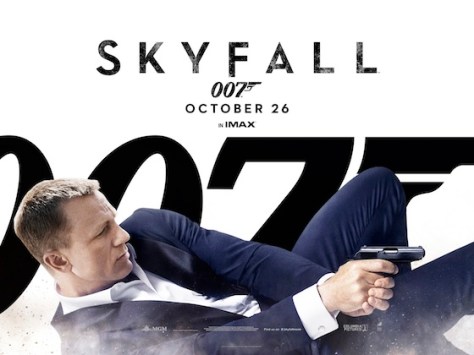
James Bond’s Right Arm is Busted. He will have to learn to shoot left-handed, or he slings a rifle everywhere he goes.

I am so proud to have accomplished what I have only managed like twice in the last 8 years. Watch a movie on the weekend of its release. Why is that? Once kids come into the picture, catching a movie in its year of release becomes a challenge.

(Spoiler alert) Yes, who can resist James Bond (seen above using deft hand to sort out his crocked right). The girls all want to watch him. The guys got no choice but to go along (hence unable to resist as well), and engage in the extremely twisted exercise of being party to their girl swoon over another man for two and a half hours. Oh what to do. I retaliate by acting positively disposed to the is-he-gay-or-is-he-not-but-he’s-got-no-teeth-so-he-mustn’t-be bad guy played by the actor par excellence Javier Bardem (seen in picture violating the ramrod straight James Bond with deft hand).

Thinking again, it’s funny. Why did I think first of Bardem when there are the Bond girls?

Awkward silence.

Ah the stunning Bond girls (seen here strategically concealing their right arms so they could appear on this blog), of course. Berenice Lim-Marlohe’s looks are as mixed as her name. When her name first came up, I first thought Singapore, and then the better senses kicked in (System 2 thinking in behavioral science parlance), and so let’s be more accurate. It’s the name of a person of Chinese descent originating from Southeast Asia, where names are not pronounced in Mandarin but in the dialect group to which the person belongs. Which is how my name (pronounced Zhang) metamorphosed into Teo of the Henghua dialect. Turns out she is French and 33. It may sound like she’s a bit mature in age to be a Bond girl, but with Daniel Craig (only 44) trying to looking 60 in this movie, 33 certainly sounds more politically-correct than 22.

Speaking of political correctness, how about that, no white Bond girls this time. Those looking for Caucasian beauty would need to plonk Judi Dench (seen here using deft hand for facial hair removal while the other hand awaits to pass the pen to it) in a time machine and crank back about 130 years. (This demographic is strangely reminiscent of the recent presidential elections…creepy.) And even then she will be taking a break the next movie. Then the same people will have to imagine Ralph Fiennes in drag (I recall he has done it before, just can’t place the movie). Though with Bond movies, miraculous resurrections are a dime a dozen, why should we be surprised.

I can imagine Ralph Fiennes’s character being really pissed though if Judi Dench does return.
Final Research Paper: Social Media in War

In the latest conflict between Israel and the Palestinians, taking place even as I blog, more than 422 rockets have been fired into Israel from Gaza City, according to the Israel Defense Forces (IDF).  Hamas gave conflicting information, tweeting that it had shot 527 rockets instead.  Wait, did I hear Hamas making a news release on its conflict with Israel through Twitter?  There is more.  IDF spokeswoman Avital Leibovich tweeted a photo of a baby bloodied from a Hamas rocket attack.  Hamas had a similar riposte, tweeting a screen shot of the mangled body of a child, presumably from heavy Israeli bombing.

This current conflict could be the one in which Twitter and other social media platforms play a most significant role in war.  Indeed, social media’s influence in armed conflict is set to grow.  Every physical, kinetic conflict has had an intangible non-kinetic side.  Of the latter, a considerable portion lies in the information realm.  From high-level strategic communications right down to tactical disinformation, information has been and will continue to be a critical instrument of power.  As the latest and most rapidly-growing propagator of information, it seems as though social media will be featured for a long time to come in war.

Thus far, much of the hype about social media has been about its democratizing effect, its ability to mobilize, to set off revolutions, and to overthrow governments.  However, not much has been discussed about its role in war.  What is its history thus far in war?  Why do warring factions appear to be employing this medium increasingly?  Has it been effective for those who use it?  What is unique about it that separates it from other forms of mass media?  How does it change the nature of information in warfare, or does it even change the nature of warfare itself? What are the other questions that need to be addressed, that are not yet addressed at this point in time?

The research paper will examine the trends in the use of social media in war, through a broad survey of the history of its use.  It will also look at the other areas in which social media has been active, and attempt to apply the discoveries and lessons of its use into the context of warfare, in order to predict the kind of influence it that is capable of having in war, as well as to examine the changes; possibly fundamental changes; that it could make to the very nature of warfare and how it is practiced.

Excuses

It is absolutely ironic that I would not have had the time to post on a 3-day weekend.  But there’s a lot going on.  A dinner party that lasted till 1:30am Friday night (a belated happy birthday to me), a sports shopping spree (I exaggerate, but how does one resist a 20% storewide discount) on Saturday morning, needing to sleep early Saturday night (the prime time of blogging – I know, I need to get a life) due to the need to arise at unearthly 5am on Sunday morning to start a half-marathon at 7:30am (brilliant, brilliant race, I ran out of my skin, I could start a new blog on it), and then now, after hammering out a draft project proposal for a left-handed professor about how to design interventions for stressed-out kids.

(There, an absolutely justified 101-word sentence.)

And my final excuse is that it’s 2 in the morning and I ran a retirement-inducing (cos it will never be bettered, not cos it stank) 13.1 miles and I should really be in bed recovering from my exertions.

So I leave you, the esteemed reader, with this left-handed link called Left Handers Day (sic).  It designates 13 Aug as the day.  A bit of fun. Just that every day for me is Left-Handed Day.

PS. The next blog post is my final project proposal for the digital media class to which this blog owes its existence.  Please excuse it, it’s the last one of those crude interruptions.

PPS. What left-handed issues do you want to read about?  Please comment.

Social Media and the Arab Spring

This post reviews the reading this week that covers social media and its role in the Arab Spring.  The article A “Cute” Facebook Revolution? by Basem Fathy posits that the 2011 Egyptian Revolution was neither one purely borne out of social media, nor one that was pre-meditated, pre-planned  and carefully pre-conceived.  It says instead that this revolution was ten years in the making, with offline actions and activism preceding the same online, and that the organization was loose and non-hierarchical.  Fathy also makes a seemingly innocuous-looking point in his conclusion that the pouring of people onto Tahrir Square on January 28, 2011 was the result of the Egyptian government clamping down on the internet and preventing people from viewing events unfold online.  This last point ties in with Ethan Zuckerman’s Cute Cat Theory, which says that social media sites are fertile places for dissident movements to start.  This is because when authoritarian regimes shut down sites like Youtube, the masses who use such sites to look at cute cats sit up and take notice.

A Tunisian-Egyptian Link That Shook Arab History by Kirkpatrick and Sanger is an excellent summary of how the Mubarak government was brought down; owing in no small part to the roles played by Egyptian bloggers and Wael Ghonim’s activism on Facebook.  Tufekci’s article The #freemona Perfect Storm is an excellent anecdotal piece on how Twitter was used to mobilize action to release an Egyptian-American writer from Egyptian captivity.  Finally, The Net Delusion (afterword to the book here) is Evgeny Morozov’s argument about how those who think the Internet is the ultimate liberator are sorely mistaken.

There is absolutely no doubting the major role played by online social media in the series of dissident movements in the Arab Spring.  This is only the latest instance of the mobilizing power of the Internet and social networks.  The earliest internet-facilitated mobilization I can personally recall was just prior to the 2003 invasion of Iraq.  According to some estimates, a total of 36 million people were mobilized for protests against this war from January to April that year.  From these readings though, one moves away from the simplistic claims of social media as the harbinger of global democratization and liberation, to the more sober realization that there is so much more to just social media generating movements and liberating masses.

Consider the humble telephone.  A great piece of technology in its time, it connects people, enables them to communicate, and even though communication is point-to-point, it can, with repeated use, enable groups of like-minded people to gather at one place to partake of an activity of common interest.  Much like social media, it can be (and indeed has been) used for benevolent and malevolent ends, and is a useful—in times gone by, essential—tool for those who seek to organize.  It is plausible to imagine that with its invention and proliferation in the late 19th century, people might have been wildly optimistic about the good things it could bring to humankind.

Yet, more than 125 years after Alexander Graham Bell invented the apparatus to telegraphically transmit sound, it is inconceivable that one might hail the telephone as the technology to liberate longsuffering peoples and democratize societies.  This is because, having thoroughly understood what the telephone is about, we know what it is capable of achieving, what its role in life is, how it can be manipulated, and when over-grandiose claims about what it brings to our lives is just hot air.

And so it could prove to be with social media.  We have seen what it can do in democracy movements.  But just as one swallow makes not a summer, it is much more prudent to not just make conclusions from the information that is easily available (what I learn from Todd Rogers’ behavioral science class as the availability heuristic).  Rather, there is a need to synthesize as well the information that is not easily apparent, and that which is not available at all (meaning, we need to go search and research).

It has only been ten years since social media burst into the scene, and there is much about it that is not yet known and understood.  While I applaud the pivotal role social media has played in liberation movements and other mobilizations that make for a better world, I am nevertheless clear on two things about it: one, that it is a vehicle and a tool (or perhaps, weapon) that serves the intention of the one who wields it; two, 125 years from now, we would label it just as what it fundamentally is—a great piece of technology, no more, no less.

Lefty Blog’s Endorsement of Whoever’s Left in the Presidential Election

Following our fellow reputable publishers The New York Times and The Economist, this blog has something to say about this election.

After a fierce campaign so close as if trying to tell one’s left hand from one’s right, it is time for Americans to choose their President.  And so it is for the rest of the world, never mind that they have no say on the matter whatsoever—my son who is in elementary school is still being asked by his teacher to vote in class tomorrow, never mind that he is underaged, and not a citizen. Now even though at this point the left hand (read: rest of the world) does not know yet what the right hand (read: Yanks) is going to do, it will all become clear, perhaps even before the last Californian at the poll booth votes—that is, if the West Coast states; also known as the left-hand-side of America; know there is an election going on, given how little they have seen of their candidates.

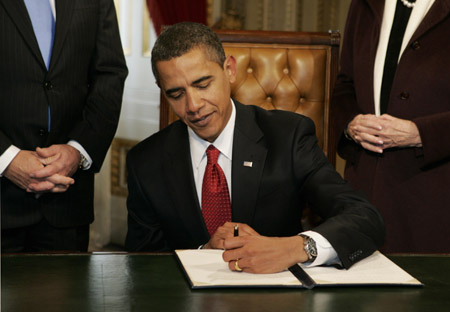
The election of Barack Obama as the 8th left-handed president of the United States was a landmark for us minorities, and cut our ever-closing American president handedness deficit to 28 (8-36).  However we would have to agree with the NYT on the fact that his election did not usher in a new era for minorities in America, given that he did not pass any new legislation that recognized our rights as minorities during his term in charge.  However, we believe that such legislation, although firmly out of left field, remains a greater possibility under Obama.  Our hopes are left slightly dimmed but unextinguished.

Voters need to know the last four right-handed presidents since Kennedy.  They are: Johnson, Nixon, Carter and W. Bush. Compare their tenures with those of the last four left-handed presidents: Reagan, H.W. Bush, Clinton and Obama.

This is in fact all that we have to say that is relevant to the election (we are after all a small publication).  The rest is left to you, the (eligible) voter.  The picture below sums up our choice for the 2012 presidential election (and serves as evidence for those of little faith in our fact-checking).

(We are not sure why we use the word we to describe ourselves, when there is clearly only me behind this publication.  Sure sounds a lot more authoritative though.)

What’s Left of the Day

I wake up.  I get off on the left side of the bed. I walk to the bathroom.  It’s time for a shave. I pick up my razor with my left hand and start to shave. I look at the razor.  The word “HYDRO” looks back at me upside down (Lefty 0-1 Righty).  Same old thing, what does one expect in this right-handed world, I thought to myself. Then I brush my teeth.  I look at the brush head. Pleasant surprise, the “Oral-B” looks back at me the right side up (Lefty 1-1 Right, and they mustn’t be selling very well). I was pleased. Time to take a leak. Flush handle is on the left.  Yes. Lefties take the lead (Lefty 2-1 Righty).

So down to the kitchen for some breakfast.  Tossed the bread into the toaster oven. Dials are on the right (Lefty 2-2 Righty). Gotta get some butter and kaya from the fridge. Fridge door opens left to right (Lefty 2-3).  Boil some water, make some coffee. Look at the tap, it’s on the right hand side for no good reason (Lefty 2-4 Righty).  I lift the mug to drink, and realize that, the sign “COEXIST” looks at me instead of shows itself off to the rest of the world (Lefty 2-5 Righty).

I swallow my toast indignantly.  Ah who cares about food.  I go up to the MacBook to check my blog stats.  Dang, mouse is on the right (2-6).  And dang, it’s contorted to fit the right hand (2-7). Power button is on the right (2-8).  So is the “Enter” key (2-9).  Pop in a CD. Slot’s on the right (2-10).  What’s left on the left then, ah the all-important “esc” key. That’s it, I’m leaving MacBook at home today.

Time for school. I hop on the bus.  Card transponder’s on the right (2-11). Thankfully, no more offence on the bus.  First class of the day, Todd RogersScience of Behavior Change. He’s left-handed (3-11)!  A reprieve.  A short-lived one though, I realized, when I looked at at my own chair. (3-12).

The rest of the school day was same old same old, with right-handed professors cancelling out left-handed ones, but a remarkable proportion of left-handed profs, I must say.  Anecdotally, about 50% (Todd will scream “insensitivity to sample size!!” at this).  It soon brings me to the end of the school day, and I need to run to the bathroom again cos my classes were piled back to back to back (in return I get no classes Tuesday and Thursday, fair deal I reckon).  The sight that I saw in there pleased me somewhat.  (4-12).

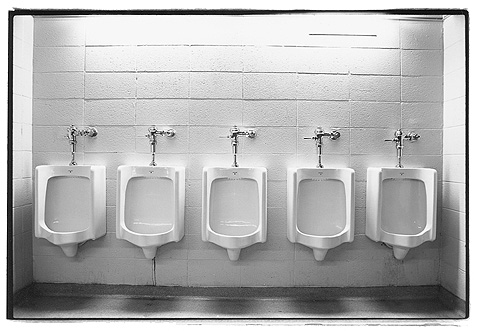
Story’s not over though. The fact that I have seen 2 kinds of flush handles fixed on the left doesn’t sit well with me. As a lefty, I am not used to such graciousness.  So I googled “flush handle” and found that about half of the flush handle pictures that google brought up were on the left. Googling “urinal flush handle” brought up an even greater majority of handles on the left.  Now knowing how mankind works, the most plausible explanation dawned on me.  It must have been designed such that the master hand for most people handles the more important implement.

So make the final score Lefty 2-14 Righty.  A right thrashing for the lefty.

PS. I just had to share this picture that I encountered on my Google adventures.

I remember being in this situation once.  Now I was laughing uncontrollably that no fly painted in the urinal was ever gonna work.

Article Review – Barack Obama: Organizing for America 2.0

What happens to the most successful online presidential campaign organization after its presidential candidate is elected?  President Obama decided to transform it into an organization geared primarily to support his policy agenda.  The idea seemed promising.  The grassroots structure and channels that had been forged, together with the volunteers that had been enlisted, would now be harnessed towards canvassing public support for the president’s policies.

However, some things will inevitably be different.  First, the personnel.  Many decided to move on, probably due to the very different nature of OFA’s work.  Second, the organization would be run from the Democratic Party rather than just a just-for-Obama vehicle.  Third, the nature of its work.  Instead of the more exciting, fast-paced work of political campaigning, it will be the more mundane, daily grind of soliciting public feedback and support for Obama’s policy initiatives.

There are supporters and detractors to OFA.  Those for the idea, not least some Republicans, say that it keeps Obama’s core constituency energized.  Some Democrats are not exactly enthused, concerned that the refreshed set-up will generate greater pressure on Democrat lawmakers.  Finally, it runs the risk of alienating supporters who will inevitably have different views from Obama’s policies on specific issues.

Surely such a successful grassroots organization is so valuable that it must be kept well for the next election in four years’ time, when online proliferation is set to be even more widespread, and the returns from a good online strategy and organization, even greater.  The question is how and in what form this organization should exist.  Obama for America was a unique organization with a very specific mission.  It is hard to just morph it into something else without it losing something in the process.  Given the larger objective of keeping its existence, I would suppose just getting it to do virtually anything just to keep its engine running, would be a good thing in itself.  But might as well make a virtue out of necessity, and let it serve some useful purpose in the meantime.

Obama has made OFA something quite close to the original OFA.  However, my opinion is that, judging from its results, it has not worked out that well.  A look at the Wikipedia page of OFA yields underwhelming reading—it has only ever done work pertinent to Obama’s healthcare reform, and not very significant work at that.  It has also come under criticism from some quarters (see one example from the Washington Post) for the way it has (or has not) worked.

In my home country Singapore, the government has its own structure to gather feedback and send out feelers on legislation and policies.  This is not conflated with partisan politics and elections.  I feel what Obama has done with OFA has served to confuse.  What originally started out as a clearly-partisan campaign platform, will find life difficult as a platform for government policy.  This is because of the fundamental difference in the target audience. In campaigning, it exists and is designed to reach out to Democrats and undecideds.  In policy, it cannot be the same audience, lest it alienates further those who did not vote for Obama, and receives feedback from those who are least likely to criticize it.

When so much of the debate over the last four years has been about bridging the partisan divide, the net effect of OFA is to exacerbate the problem.  Obama could have done this better by maintaining it as a just-for-Obama vehicle, rather than let it become an organ of the Democrat party.  Better still, keep the organization trained on campaigning and election business, and if he needed an organization for his policies, create a new, non-partisan one.  He should remember that he campaigns to his supporters, but devises policies for all Americans.

God’s Best Intentions

I always had a theory ever since I discovered Hebrew was written right to left.  Now we lefties know the kind of crap that we gotta go through having to write in a language that moves from left to right.  You end up with dirty hands, smudgy writing, and reproach from your schoolteacher for having no pride in your work.  Chalk was ok, ink sometimes smudged, pencil always gave me this silver sheen on the outside of my hand (rectify by giving a right-handed friend an encouraging pat on the back), and writing on transparencies…let’s not even bother.

I’ve seen many lefties adjust their writing posture to circumvent this smudgy issue. Some contort their deft hand such that their hand is above the line of writing. I have seen others rotate the paper 90 degrees and then write vertically (hopefully they turn the paper anti-clockwise cos turning it clockwise would just defeat the purpose wouldn’t it). Me, I’m just the live-and-let-smudge kinda guy.  If people are not able to see past my supposed untidiness and be able to conclude from the obvious signs that I am deft-handed, I figure they’re not really worth me fussing over.

So, back to my theory.  Yes, I got excited when I discovered that Hebrew (one of a clutch of languages) was right-to-left. Finally, a language I could call my own!  Another reason to get excited was the possibility that God made all his people left-handed to begin with, which would make sense for this ancient language to go right-to left—so that an entire civilization wouldn’t get their hands smudged.  Makes so much practical sense.  If one considers that the ancient civilizations of the Hebrews, Arabs and Chinese had their words right-to-left, and throw in Michelangelo’s assertion that Adam was a lefty (look, if the master has some idea of what God and Adam and the angels look like that we can all accept and admire…see painting in previous post), one might actually have a pretty solid case.

If, of course, one could conveniently ignore the fact that these ancients inscribed their words before they wrote them in ink…

And, if one needed confirmation, refer to Solomon’s (reputed to be the wisest human of all time) words in the Bible, from the book of Ecclesiastes:

A wise man’s heart is at his right hand,
But a fool’s heart at his left.

But hey, of course the wise man’s heart needs to be on his right.  His left is probably busy carving words into stone.

Incongruence

Doesn’t this blog look weird? It claims to be a blog for lefties, but then posts on lefty perspectives are interspersed with ill-fitting articles about Wikipedia, social networks and the apparent demise of the printing press. What’s it all about?

I apologize but there’s a method to all this madness. See, I’m taking this course on digital media at the Harvard Kennedy School, and one of the assignments of this course is to start a blog with your own domain name (start a blog for homework, how cool is that? Much more than working through calculus problem sets, I can say that for sure).

Another cool thing on this course is that one turns in homework by posting it on one’s blog. So once in a while (every 2 weeks, to be exact), my esteemed readers (some gratuitous flattery to keep you coming back) will get some unexpected 800-worder on some digital media issue that has got absolutely nothing to do with the deft hand. It will look super-boring unless you are a nerd (you know who you are…those who are not, don’t worry I’m not being mean and neither will those who are take offense cos it’s a legit and unoffensive term to describe who they are…and by the way, I am not a nerd so don’t call me one). Furthermore if you are charitable and would like to help me graduate from the Kennedy School, you could like those posts to influence the faculty grading it. I would be most grateful. (Though by no means am I suggesting my professor is the pliable sort, no way. Not in any way/shape/form. I should probably have deleted this…ah well…)

While you mull on my rambling, I will be spending the weekend mulling over what to write to Professor Nye (read: midterm paper!!). So remember me in your prayers.