
“Newspapers and Thinking the Unthinkable”, by Clay Shirky

Doomsday!  Clay Shirky in this blog post predicts the end of newspapers as we know it.  He says that the “unthinkable”—a scenario in which copying is widespread and content is free—is already taking place, but the print media industry has still got its head in the sand, using their set old ways to try to overcome what is happening around them.  The result is that the industry is paralyzed, unable to plan its next move to respond to what is taking shape right before their very eyes.  This is nothing less than a revolution for print media, simply because it has ceased to be the solution to the now non-existent problem of making information available to the public.

Shirky recounts the revolution that the printing press itself created in the 1500s, and claims that the printing press is now itself under threat from a similar revolution brought about by digital media.  However the primary reason that newspapers are in trouble is the impending loss of their monopoly on the advertising dollar.  In the internet age, individuals and corporations are free to go directly online for their advertising needs, omitting the newspaper publishers in the process.  And what happens from here? Shirky himself does not profess to know what will replace the newspaper’s role, and how, when it is gone. What he does profess to know though, is that the entire domain of journalism will go through a period of experimentation to find the next big thing to replace newspapers.

In his deeply influential book The Structure of Scientific Revolutions, Thomas Kuhn postulates that science does not progress in a linear fashion, but undergoes periodic revolutions known as paradigm shifts, in which the nature of scientific inquiry is abruptly transformed. He explains that scientists within a specific paradigm tend to see things in a certain way, and this clouds their vision, making truly major scientific discoveries rare.  However, when paradigm shifts do occur, a new worldview is formed that is radically different from the old one, transforming scientists’ view of the world.  The classic example of such a revolution is the Copernican Revolution (incidentally also mentioned in Shirky’s blog post), in which the Ptolemaic theory of Earth at the center of the galaxy with the celestial bodies revolving around it, was displaced by Copernicus’ discovery of a heliocentric solar system.

What Shirky describes sounds extremely similar to a Kuhnian scientific revolution.  The last paradigm shift was the printing press in 1500, and the next paradigm shift taking place right now, with digital media the heir-very-apparent.  Those whom Shirky describes with their proverbial head in the sand are the “scientists” of the old paradigm, still steeped in their outdated assumptions and trapped in their confirmation biases.  If the analysis of scientific revolutions can be further applied to Shirky’s digital media revolution, Kuhn said that in the natural progression of paradigms, once the new framework is selected, there will be widespread consensus on the appropriate choice of methods, terminologies and experiments contributing to increased insights, and problems (“puzzles”) will begin to be solved in the context of the new paradigm.  Using Kuhn’s model, I would add to Shirky’s piece to say that, over and above experiments, the publishing world can expect to see new methods, innovations and terminologies generating new insights and “mini-discoveries” in the brave new world of online publishing.

I thought Shirky’s most impactful line in his post is “Society doesn’t need newspapers. What we need is journalism.”  May I be so bold as to suggest another amendment to Shirky’s post? What we need is good, honest journalism. Now if the profession of journalism is to go the way of Groundswell; that is, if people are going to get good, professional journalism from one another instead of from institutions, then how does the common person obtain the training in order for her to get to the level of professional journalism?  I became concerned that unlearned, fly-by-night journalists might soon be flooding the market.  My fears were allayed somewhat after some googling, in which I found some self-help guides to online journalism.  The content exists.  bighow.com for one is a huge resource for budding online journalists. With a coming tidal wave of journalists coming online in the foreseeable future, what the world needs is: first, professional training to keep them proficient; and second, ethical training to keep them honest.  The resources are there, will the online journalists consume them?
lefties artistic? you can kiss my left butt cheek.

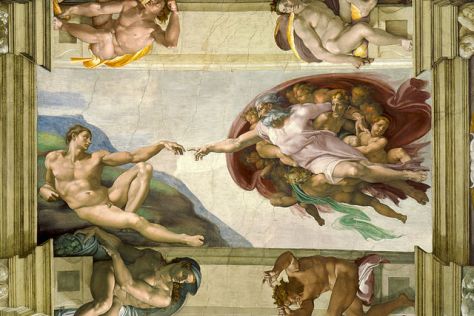
Michelangelo’s The Creation of Adam.  Note Adam’s master hand. The Master might have been on to something.

Leonardo da Vinci.  Michelangelo. Raphael.  Rembrandt.  Yes, you’ve guessed it . All of these masters are left-handed (doesn’t take a genius, actually).  For some reason, “they” say lefties are artistic.  Apparently, this has to do with being right-brain dominant.  And apparently, the right brain controls one’s artistic faculties. And therefore, a manifestly left-handed person would tend to be artistic. So “they” say. Whoever “they” are.

This kind of stuff is hard to prove.  I haven’t tested every single lefty in the world, so I wouldn’t know. I’d tend to go by personal experience. And I have one thing to say.

If left-handed people are artistic, then why do I suck in Art?

I absolutely disliked Art (as in the subject in school, not “a visual object or experience consciously created through an expression of skill or imagination”; hence the capital A) since the day I attended school and had to do it in class.  I do (present tense, since I am still in school) pretty decently in school, and whatever (else) I wasn’t good at, I would work at it until I was decent in it.  Not Art.  My Art was abject misery.  I got C’s most of the time, and I believe my Art teachers were being nice. Sometimes I got D’s and F’s.  There was an occasional B and only one sad A ever in my Art career.

I remember that A well.  It was for potato prints.  The poor student, having accepted the mission of producing potato prints for his next Art class, would have to beg his mother for a wretched potato (if not, beg her to go get one from the market), explain to his father why he was cutting it up and colouring it instead of making french fries with it, and convince his frugal grandmother why, having done the potato print, why it was not recommended to cut out the surface that was painted on and use the rest of the potato for french fries.  (Teachers, when you assign weird homework, do consider the collateral work/damage/corporal punishment that may result).   The result (that is, the one on paper) was fantastic (sarcasm intended). I had cut a shape that resembled an asterisk on the inside of a potato (a noble one, I might add, that had managed to help create art rather than get eaten), splashed some paint on the cut surface, and printed the surface in straight lines across the paper that was to carry my masterpiece.

“Very nice, Chenghan, you got an A this time.” said Mrs Chia.  “But you could have improved it by making it more interesting by making half-potato prints on the edges of the paper instead of ending with a full potato print and leaving empty spaces at the edges.”  Improve on an A-grade piece of work?  That would make it an A+ piece.  I wouldn’t dare dream of it.

Rare is memorable.  My vivid (I did not cook any of that stuff up, honest! With the exception of the Art teacher’s name, which I think has a 50% chance of being correct) recollection of the events surrounding my only A ever in Art is ample and sufficient evidence that it was my only A ever in Art.  That Everest, sadly, was surrounded by Death Valleys everywhere else. Now why was I so bad? I would argue that it was precisely my left-handedness. 2 reasons:

First, I could not cut.  (I neglect to say that Art in school was actually Art & Craft. Sorry, Craft, for omitting you.) I always wondered why my scissors always left frayed edges all over, and why they always consistently missed the line it was supposed to cut along.  It was a tragedy that I only first encountered a left-hand scissors when I was 15, a year after my last year in which Art was a subject in school. If righties don’t know wtf I’m talking about, I forgive them.

Second, I was taught to draw by right-handed people.  And how do right-handed people teach left-handed kids to draw? They use their left-hand to guide their guinea pigs’ left hands.  So I inherited my right-handed teachers’ messed (I had meant to be much more rude about it) up left-handed drawing.  By some miracle I managed to save my handwriting; not so my drawing. I recall a concerned Mom sending an 8-year-old me to extra drawing class and I had trouble with still life featuring a loaf of bread. Yes, let’s call it as it is. I had trouble drawing a cube-like shape. Ouch.

So in Art & Craft I was never really any good.  For me, it was more like Fart & Graft.

A Post About This Post

This post is so so late. Too late to catch the weekend viewership.  That essentially means only half of you will get to read this than if I posted this on Friday night. In Singapore where I normally live, the weekend would have been almost over, and this would be getting the depressingly low Monday viewership.  It’s a fact—my stats tell me that people don’t read blogs on Mondays. I suppose there are much better things to do on a Monday, like go to work or school, read the newspaper, or wallow in your Monday blues like Garfield does, instead of reading something silly that only concerns a small minority of humankind. By the way, this was the first mention of Garfield in my life since those shockingly depressing movies he made some years ago. Has his arteries finally clogged on him? Or did Odie finally decide to become a real canine and mauled a feline?

But you know in Massachusetts where I now live, this wouldn’t be that late—it’s the Columbus Day weekend! So there are two more days of weekend left after I post this.  It’s my first long weekend post! Let’s see how it works out.

If you get the feeling that I am obsessing about my readership, I certain am not. (By the way, please share this blog with your left-handed friends).  Though sometimes I do feel like a movie executive wondering when to release the latest Scott Baio (I was trying to think of an actor that people used to know and no one else can remember and I saw him in a Nickelodeon sitcom last night and was surprised he is still in showbiz…this mention of him will absolutely not help to spike readership) movie that no one wants to watch. (Oh and by the way, please share this blog with your right-handed friends too. This equals to sharing with all your friends. And don’t forget your family, you love them too). And most importantly, I don’t watch Nickelodeon, Baby was messing about with the TV channels.

And why was I late? Apart from the fact that I am spending the weekend in the White Mountains of New Hampshire for the long weekendImage, I was conned by my professor into reading pages and pages of mind-numbing stuff, which I spent the last night doing.  At this point, I can only hope that my resultant knowledge of the fact that the Portuguese helped to transport tons and tons of spices to Europe from Southeast Asia in the 15th and 16th centuries will come to good use at some point. Wait, or was it the 14th and 15th century?  Wait some more, why couldn’t the Europeans just eat with salt and vinegar? Sure goes great with potato chips

I read the post I have written thus far and realise that this has become a Seinfeld post (Alert! Seinfeld performs at Wang Theater on 17 Nov! Woo hoo!).  I honestly did have a topic in mind, but if I carried on, I would take too long blogging, and you would take too long reading, and so I thought I’d move on to hopefully less mind-numbing reading and to see some stunning fall foliage, and you might want to continue to wallow in your Monday blues or to carry on with your long weekend blast, depending on which part of the world you live in. Till next time then. Because the one who doth mess around with the TV channels riseth…

Reviewing How to Thrive Online by Howard Rheingold, Chapter 5 Social Has a Shape: Why Networks Matter

Networks have existed for a long time, but we have only recently started to understand them.  From the linear Sarnoff’s Law to the exponential Metcalfe’s and Reed’s Laws, we are only beginning to comprehend how networks work.  Rheingold goes on to write about the social networks that exist online and the ways to analyze them (social network analysis, or SNA).  One way is the strength of ties within the networks.   He also shares his friend Marc Smith’s advice to “be a bridge” between networks and communities and linking them together (see this blog which has a link on the study of connected networks). Rheingold postulates that networks today center around the individual—a phenomenon termed “networked individualism”—and that the individual; rather than connect with just their respective communities in the past; today connects simultaneously with many diverse and overlapping networks.  From there, Rheingold goes on to talk about social capital—what he calls an individual’s or a group’s capacity, derived from trust and reciprocity, to accomplish collective action.  He concludes with a section on the ubiquitous Facebook and how it can be used to increase one’s social capital.  Rheingold’s key conclusion is that such networking and social media tools enable people “to do bigger, more powerful things together.”

Rheingold in this chapter gives a comprehensive review of networks and their strengths.  I enjoyed the new perspectives about relationships that networks; especially social networks; have shed light upon.  A notable one is the new significance that weak ties enjoy in our newly-networked world.  Where previously without social media and online networks, weak ties were virtually dead and of not much use, today our online networks seem to have sort of an hibernating effect on them, keeping them dormant, preserving them, until such time when they are needed, when one could awaken them for one’s own purpose.  Where my high school classmates, or random acquaintances, for that matter, may not remember or recognize me if there were no Facebook, today if I contacted them from out of the blue (say, for the first time in twenty years), it wouldn’t seem at all weird! OK, perhaps just a little bit weird, but not nearly as weird.

However, looking at the chapter holistically, I feel that Rheingold could give the subject a more comprehensive treatment by looking not just at the pluses, as he has admirably done, but at the minuses as well.  For all the strengths of networks and their ability to harness social capital for benevolent ends, these very strengths could be used for malevolent purposes as well.  In this regard, I find Rheingold’s account overly sanguine about the uses and purposes of networks.  I thought there was scope for his chapter to sound a cautionary note about the power of networks and how it could be used to create negative value (capital).  Rheingold could have used some examples on how networks have been used by transnational terrorist groups, and offered some ways on how these could be countered. (Disclaimer: Not having read the rest of the book, I am not sure if he had already covered this somewhere else. I personally doubt though.)

Networks do matter in connecting people all over the world and bringing them closer together.  This brings to mind the Globalization course that I am also taking this semester, taught by Professor Dani Rodrik.  He postulates that globalization is measured by way of transaction costs; that is, lower transaction costs are an indication of higher globalization, and no transaction costs indicate perfect globalization. He proves, furthermore, that in the domain of trade, transaction costs are still some way from zero.  On the social network front, however, transaction costs appear to be zero, if not very close to it.  However, thinking deeper, there is still some way before interconnectedness in this domain becomes complete.  People are still separated (disconnected) by language, for one.  The “transaction cost” in this case; to borrow Prof Rodrik’s idea; would therefore be the effort and time needed to translate from one language to another.  This, in itself, would constitute a considerable transaction cost.  This is where Rheingold’s “be a bridge” advice would help bring about more globalization and interconnectedness in the world of online social networks.

Offspring

Friday wasn’t a bad day. In weather terms it was simply awful, it just rained and rained and rained here in Cambridge, Massachusetts. But I could handle H2O (and a bit of crap that managed to dissolve into it on the way from 25,000 feet back to earth) coming down in little droplets. In school terms it was alright, a couple of classes; a last-minute attendance at a job fair in which I was conspicuously the most-comfortably dressed (read: least well-dressed; I tend to like to see things from the bright side) person in the room; a fascinating reading about the errors of Robert McNamara during the Cuban Missile Crisis and the Vietnam War (a must-read for aficionados—find The Fog of War on Amazon.com). In family terms it was great, a rare opportunity to interact exclusively with the only other adult member of the family for a relatively sustained period of time (read: date night!). And in food terms, a delight in which the antipasto trumped the pasto and the postpasto (apologies Italians, I am so mangling your language)—a delight at Caffe Vittoria—trumped all else.

So it wasn’t a bad day by any measure. Except when Wifey dropped the bombshell over dinner.

“I think Baby is right-handed.”

See, I have three youngins and that makes three of them righties.  Don’t get me wrong they are fantastic kids and I love them so but in this solitary aspect, three times I have been disappointed.  I have done my part though.  For one, I have always ensured I hand them the pencil/pen/crayon/their mom’s lipstick on their left-hand first. Every time, the left hand of the boy would then pass the drawing tool to his right, and the right would then proceed to create the next masterpiece. Without fail.  As someone who looks on the bright side (sometimes to the point of delusion, as you shall see), I tell myself it’s the left hand bossing the right hand around. In moments when I am more grounded in reality I just say not again.

Many well-meaning friends and strangers look at our three boys and suggest to us in half-amusement (and sometimes with a straight face, can you believe it) that we should try for a fourth so that we “will” get a girl.  To this remark I usually have a couple of responses that I mutter under my mind’s breath.  Apart from the one about them needing a class in stats and probability to sort out that aspect of their life so that their own personal decisions in the future will not be as screwed as the past decisions they had previously made with this bad piece of math, I have a more pertinent response (pertinent to this blog anyway).

Forget the girl, I might be tempted to try for a lefty.

Wikipedia’s Take on the Matter

This blog is all about being left-handed.  I (Deftleft in Wikipedia-land) shall use this post to take a look at what Wikipedia—according to itself (or more accurately its volunteer authors) “the largest and most popular general reference work on the internet”—says about left-handedness.  Disappointingly, there isn’t a Wikipedia page for left-handedness; it turns out that a search for the term “left-handedness” brings up the Wikipedia page for “handedness”.  However, this page has got ample information—probably the most of all—pertaining to the use of the deft hand and therefore it enjoys the privilege of this blog’s review.

By a rather crude estimation, one would have expected this page to cover left-handedness and right-handedness equally.  Yet, this is not the case—this page reads like a page for left-handedness, and I estimate that more than 80% of the page’s content is about being left-handed.  Of course one could argue that, given there are only two aspects to handedness, by discussing one, the page is effectively discussing the other.  Furthermore, there are only so many things one can discuss about being right-handed.  Therefore overall, I was quite prepared to forgive the apparent lop-sidedness of this article.

The page for the term “handedness” is long and appears comprehensive.  Without first looking at the page, I would have expected it to cover the key issues of being left-handed, such as the causes, the science behind handedness, peculiarities of left-handed people, discrimination of lefties, and design of products for lefties.  All of these issues were covered, and more.  However, so much material was covered that I thought some of the minutiae, such as the section about the handedness of US Presidents, could just be separately placed in a trivia section at the end of the article.  But all in all, no problems with the comprehensiveness of the article.

The sourcing was mixed.  A look at the source list at the bottom of the page yields sources that are virtually all serious and credible, with not a few being scholarly articles.  On the other hand, there were some assertions in the article that required citations but came with none.  Wikipedia itself suggests that the number of “weasel words”—assertions that come with vague or weak attribution—in the article is many.  On neutrality, I had previously stated that the article was about 80% (probably more) on left-handedness.  It does appear as though that most of the contributors of this article are left-handed and not right-.  The whole article comes across as having a left-handed bent to it.  I am inclined to think that not many who are right-handed would be too enthusiastic about this topic.  This article would therefore benefit from a right-hander’s (or two) perspective on this issue.  Apart from this, even certain critical issues, like the causes of left- or right-handedness, are seeing debate on its talk page.  Wikipedia states up front that the neutrality of the article is disputed.

The formatting of the article appears haphazard and not very readable.  Given the volume of information included in the page, this article would benefit from better organisation and a culling of less important aspects of handedness.  There lacks a systematic order to the way the topics and sub-topics are arranged.  This could be rectified by closer adherence to Wikipedia’s manual of style.  Illustrations are present but are rather sporadic throughout eh article.  A couple of graphics accompanying the more important issues of handedness might help—for example, one to illustrate the genetics of handedness.

Overall, this page is good on content but has room for improvement on the aspects of neutrality, organization and readability.  It could definitely do with a structural reorganization, to begin with.  Editors could then comb through the article to resolve the issues of sourcing and neutrality in general.  It is a slight downer to see your pet topic addressed in a less than ideal manner as it is on this page.  Nevertheless, reading this page was a fairly educational experience that would raise good awareness behind the notion of (left-)handedness. Let’s see what we can do to help this page along.

How It All Started

It’s one of those things. No one ever remembers the day one decided that one was going to be left- or right-handed.  Presumably, a toddler picked up her pencil/pen/crayon/mother’s favorite lipstick and started to doodle on the paper/table/floor/original Mona Lisa way before she could retain memories in her head.  (If you happen to read this and do remember, do leave a comment and share your amazing experience, or the reason why your parents gave you something to write with so late in life).  Almost like being circumcised.

One of the earliest indications of my minority status came up at the dining table. During dinners with the extended family, when we would take turns to sit at the round dining table (because there were more people than seats at that table), some family members would suggest that the lefties sit together so they would cause minimum disruption to the table procedures of the rest.  However my most vivid memory was when, I musta been about 6, Mom decided one day that it was not good for a child to write with the left. I was, and still am, not quite sure what caused her to suddenly think that there was a need for such radical reforms.  At 6, I thought I was doing pretty ok.  Did a mean uncle tell her about how my left arm impeded his quest to be first to the chicken drumstick? Or did she come across dodgy research about how lefties have 10 years less on this wonderful planet?  A clue I hadn’t.

But one day she decided that it wasn’t good. She sat me down on my home dining table (square, so the person who snitched musta been someone from the extended family), and told me that I needed to practice writing with my right.  My memory fails me ‘cos it was so long ago (sometimes I wish I journal’d), but there was some yelling, some corporal punishment, some tears (on my part), and strong resistance.  Now I am no longer able to recall why the strong resistance.  Maybe the right-handwriting was so atrocious even a 6-year-old like me could tell it was fugly. Bottom line was, Mom failed utterly at that instance (I don’t blame her at all, she did what she did out of love, and she is a fantastic mother). And that thing that was and is so intrinsic to the person that I am, survived. It survived to join me to face the rest of this strange world for the rest of my life.

The Impulse Post

It’s 2:33 in the morning. I really should be asleep (though at this time I normally am not, but I digress). All I had wanted to do was to update the “About” page, hopefully type something funny/witty, then go to bed.

But it didn’t turn out that way.  While updating the page, I thought I’d check out the Thesaurus at http://www.merriam-webster.com to see what they had to say about being left-handed…you know, pick up a few words to describe my freak-feature…like “southpaw” and err “left-handed” and…I guess that was it.  And then this caught my eye:

left–handed adjective

1 lacking or showing a lack of nimbleness in using one’s hands <I’d rather have no help at all than have his left-handed “assistance”>

Now whassup with that.  Lefties deserve a lot more respect than that.

I read on…

Synonyms awkward, butterfingered, cack-handed [British], graceless, ham-fisted, ham-handed, handless, heavy-handed, left-handed, maladroit, unhandy

Related Words uncoordinated; bunglesome, bungling, gauche, inept, inexpert, unskilled, unskillful

Near Antonyms expert, masterly, skilled, skillful; coordinated

Antonyms deft, dexterous (also dextrous), handy, sure-handed

That was a lot more insult than I could have taken for one evening. What is “cack-handed” anyway?  Who knows what that means but it’s the words you don’t know that sound the most insulting (M-W: You mean you don’t even understand the meaning of that insult? Me: At least that is less moronic than saying the synonym of left-handed is left-handed, moron.)

So, the origins of this post laid out.  Yes it took a bit of egging on, but this was precisely the reason why this blog was born.  Since the days of King David (the Bible doesn’t say, but he seems like a lefty sort to me…he’s a songwriter for goodness’ sakes), lefties have suffered the tyranny of the majority in a world designed for people who work with the wrong hand.  We have suffered inconvenience, been unappreciated, taken for granted, patronized, discriminated and some of us lefties don’t even have the slightest idea because it has been like this since the day we were born. Well, this is the place where you will come and feel the love, my sister/brother.  This is the place where you will feel right at home.

End of impulse.